learnGetting started
How long should an AI video prompt be? A budget per engine, set by the length of the shot
None of our engines publishes a word limit. We size each prompt by the shot instead: one beat per 4 to 8 seconds, the reference token inside it, and the retake it costs.
by reeldouble · November 4, 2026 · 6 min read
Nobody publishes the number
Search for how long an AI video prompt should be and you get ranges. One guide says 50 to 200 words for Kling. Another says 80 to 150 for Veo, Runway and Kling. A third says keep it under 150 because a 500-word prompt confuses every model. We looked for an official word or character limit from Kuaishou, ByteDance and Google for the engines we run, two days in a row, and found none.
The most useful line we read came from a Veo prompt guide: a prompt is too long once it asks for more than one shot can show. That moves the question from words to seconds, and seconds are something you choose before you write anything. So this page sizes the prompt by the shot, engine by engine, using the lengths and reference rules in our own engine file.
Count beats, then words
A beat is one thing the viewer sees happen: she turns, the door opens, he laughs. Our working rule for the shelf is one beat for a 4-second shot, one or two for 6 to 8 seconds, and no more than three in a 15-second take. Words follow from that. A beat with a subject, a setting, one camera move and the light usually lands between 40 and 70 words. The character block adds to it.
What goes wrong with a long prompt is rarely the word count itself. It is a second or third action squeezed into a shot that has time for one. Blendnow's prompt guide puts most "the model ignored me" results down to contradictions and repeats, and suggests writing subject, action, scene, camera, lighting and style in that order. We follow the same order.
The budget per engine
| engine | one render | beats we write | where the character goes | reference token |
|---|---|---|---|---|
| Veo 3.1 Fast | 4, 6 or 8 s; 8 s with a reference | 1, at most 2 | first sentence | image 1 to image 3 |
| Kling O3 Pro | 4 to 30 s; 15 s a shot | 1 to 3 per 15 s shot | first sentence of each shot | @Element1 to @Element5 |
| Seedance 2.0 and 2.0 Fast | 4 to 15 s | 1 to 3 | first sentence | @Image1 to @Image9 |
| Seedance 2.5 | 4 to 30 s | up to 5 across 30 s | first sentence | @Image1 to @Image30 |
Veo 3.1 Fast has the tightest frame. Lengths are 4, 6 or 8 seconds and nothing in between. Any render with a reference image is 8 seconds whatever you ask for, so a Veo prompt with a character in it is always an 8-second prompt. We write one beat and a camera move.
Kling O3 Pro caps one generation at 15 seconds. A 30-second Kling render on ReelDouble is two 15-second shots joined in our own process with the same characters in both. Write it as two short scenes, each with its own beats, and keep the character's description the same in both.
Seedance 2.0 takes one render up to 15 seconds and nine reference images. The Seedance guides we read agree on one key action per prompt and describing what you want instead of listing what you do not.
Seedance 2.5 runs to 30 seconds in one take, so it is the only engine on our shelf where a long prompt can be the right prompt. Even there we keep each beat to a sentence or two.
Where the character block sits
Put the reference token and the character's fixed traits first, then the action. A token buried in the middle of a paragraph is the easiest thing for a model to drop, and one Seedance tips post reports the same for motion verbs placed mid-prompt. The block is the same words on every shot of the episode. Our descriptor block page shows how we write it, and element versus image syntax covers why Kling says @Element1 where Seedance says @Image1.
One detail from our engine file: Veo has no token syntax at all, so the studio writes its references as "image 1", "image 2". Those words are kept no longer than the other two engines' tokens, so a prompt that fits one engine still fits when you switch it to another.
What an overloaded prompt costs
A render that comes back with the wrong action is billed like any other render, and the fix is a second render at the same price. That is the real cost of a prompt that tries to do too much:
| shot | first render | retake | total |
|---|---|---|---|
| Veo 3.1 Fast, 8 s, voiced | 240 | 240 | 480 |
| Kling O3 Pro, 15 s, voiced | 450 | 450 | 900 |
| Seedance 2.0, 15 s, 720p | 675 | 675 | 1,350 |
| Seedance 2.5, 15 s, 720p | 1,050 | 1,050 | 2,100 |
Splitting the same 15 seconds into two shots of 7 and 8 seconds costs the same credits as one 15-second take on every engine that bills by the second. If one of the two shots fails, you retake half the time. That is why we split crowded shots first and write long prompts last.
Our retry page has the rest of the retake workflow.
When the script is longer than one prompt
Sometimes the writing outgrows a single shot no matter how you trim it. In ReelDouble the writer turns a long brief into a scene list when you press generate, one prompt per scene, and that conversion costs nothing. Tightening a single prompt with the writer is 5 credits, which is a small fraction of one retake. Our script length per shot guide covers the spoken half of the same problem: how many words of dialogue fit in a clip.
A worked example
Here is one 8-second shot written three ways.
Too long, around 120 words: the character walks in, notices the box, picks it up, opens it, gasps, looks at the camera, says a line, and the camera pushes in while the light shifts to dusk. That is five or six beats in eight seconds.
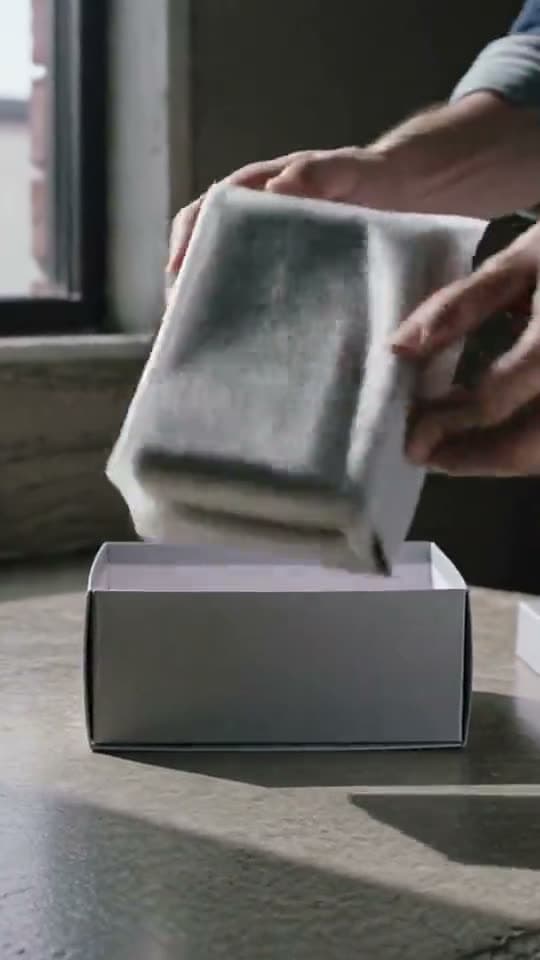
About right, around 55 words: @Image1, the woman in the grey blazer from the reference, walks to the window ledge and lifts the lid of a small white box. Soft side light from the left. Slow push-in at chest height. She smiles at what she sees. Quiet room tone.
Next shot, separately: the close-up of her reaction and her line.
Build both in the studio with the same character tagged, and the quote under each prompt tells you the cost of every beat before you render it.
FAQ
How many words should an AI video prompt be?
No engine we run publishes a limit. ReelDouble sizes prompts by the shot: one beat for 4 seconds, one or two for 6 to 8 seconds, up to three for a 15-second take. That usually comes to 40 to 70 words per beat plus the character description.
Does Kling have a prompt length limit?
Kuaishou does not publish one that we could find. On ReelDouble, Kling O3 Pro renders up to 15 seconds a shot, and a 30-second render is two 15-second shots joined with the same characters, so write each half as its own short scene.
Why does the AI video model ignore part of my prompt?
Usually the prompt asks for more actions than the shot has time to show, or it contradicts itself. Put the character first, give the shot one main action, and move the extra beats into their own shots.
Is it cheaper to make one long AI clip or two short ones?
On engines that bill by the second, two shots of 7 and 8 seconds cost the same as one 15-second take. On ReelDouble a failed short shot costs less to retake, so we split crowded shots before we write a long prompt.
Where should the character reference go in the prompt?
At the start. Put the reference token, such as @Element1 on Kling or @Image1 on Seedance, and the character's fixed traits in the first sentence, then the action. Keep that sentence identical on every shot.